




Progressive Overload: What It Is and How to Use It to Build Muscle
Progressive overload is the number one principle of strength training. Your body adapts to the stress you put on it, so if you keep doing the same thing, it has no reason to change. To build muscle and get stronger, you have to gradually increase the challenge, workout after workout. Simple in theory, yet plenty of lifters use the same weights for months. This guide explains what progressive overload is, the six ways to apply it, a proven progression model with real numbers, and what to do when you hit a plateau.
What is progressive overload?
Progressive overload is built on adaptation. When you expose a muscle to more stress than it's used to, it gets disrupted (mechanical tension, fatigue, micro-damage). During recovery, your body adapts: muscle fibers grow, your nervous system recruits motor units more efficiently, and tendons get stronger.
Once you've adapted, the same workout is no longer a challenge. If you bench 135 lb for 3x10 for six months straight, your body has no reason to build more muscle. Progressive overload is the art of raising that challenge at the right pace: enough to stimulate growth, not so much that fatigue becomes unmanageable.
Why beginners progress fast (and then slow down)
In the first months, almost anything works: your nervous system is learning the movements and your lifts go up every session. This phase usually lasts 3 to 9 months. After that, progress naturally slows from session-to-session to week-to-week, then month-to-month. That's normal, and it's exactly when a structured progressive overload plan becomes essential.
6 ways to apply progressive overload
Adding weight is only one option. Here are the main variables you can adjust:
| Method | Example | Best for |
|---|---|---|
| Add weight | 135 lb x 8 → 140 lb x 8 | Compound lifts, beginners and intermediates |
| Add reps | 3 x 8 → 3 x 10 at the same weight | Every exercise, especially isolation |
| Add sets | 3 sets → 4 sets per exercise | Lagging muscles, volume phases |
| Improve execution | Full range of motion, 3-second lowering | Beginners, poorly mastered lifts |
| Train more often | 1 → 2 sessions per muscle per week | Intermediates who've stalled |
| Increase density | Same work with 15 seconds less rest | Conditioning, short workouts |
1. Add weight
The most direct form. Use the smallest jump available: 5 lb on a barbell (2.5 lb per side), 5 lb on dumbbells. If your gym has fractional plates (1 to 1.25 lb), use them on overhead press or curls: adding 5 lb to a 60-lb lift is an increase of more than 8%, which is a big jump.
2. Add reps
Doing 10 reps instead of 8 with the same weight is real progress. It's the easiest method for small muscles and for exercises where the weight jumps are too big.
3. Add volume
Adding a set per exercise or per muscle increases the total stimulus. But volume has a ceiling: beyond roughly 20 hard sets per muscle per week, fatigue often outweighs the benefit. For most lifters, 10 to 20 hard sets per muscle per week is the productive zone.
4. Improve technique and range of motion
Squatting deeper, pausing on the chest during bench press, controlling the eccentric: at the same weight, the effort is higher and the stimulus is better. For beginners, this is often the most valuable progression in the first weeks.
5. Train more often
Going from one chest session per week to two lets you spread volume and accumulate more quality sets. It's a powerful way to restart a stalled muscle group.
6. Increase density
Doing the same work in less time makes it harder. Be careful: on heavy lifts, shorter rest usually costs you reps. Keep this method for isolation work or conditioning sessions.
Double progression: the simplest progressive overload model
If you only remember one method, make it this one. Double progression combines reps and weight:
- Pick a rep range, for example 8 to 12.
- Choose a weight that lets you do 8 clean reps on all sets, stopping 1 to 2 reps short of failure.
- Each session, try to add at least one rep to one of your sets.
- Once you hit 12 reps on every set, increase the weight (2.5 to 5%) and start back at 8.
Example: 6 bench press sessions
| Session | Weight | Set 1 | Set 2 | Set 3 |
|---|---|---|---|---|
| 1 | 135 lb | 9 | 8 | 8 |
| 2 | 135 lb | 10 | 9 | 8 |
| 3 | 135 lb | 11 | 10 | 9 |
| 4 | 135 lb | 12 | 11 | 10 |
| 5 | 135 lb | 12 | 12 | 12 |
| 6 | 140 lb | 9 | 8 | 8 |
In five sessions, you went from 25 to 36 total reps at 135 lb, then moved up in weight. This kind of progression can run for months on most exercises. To pick your starting weight, estimate your max with the estimated 1RM from the mebody workout tracker: a load around 70 to 75% of your 1RM usually lands in the 8-to-12-rep range.
Realistic weight jumps by exercise
Not every lift progresses at the same rate. Big lower-body movements use large muscle groups and can handle bigger jumps; small upper-body and isolation lifts can't. Use these as starting points when you reach the top of your rep range:
| Exercise | Typical jump | If the jump is too big |
|---|---|---|
| Squat, deadlift, leg press | 5 to 10 lb | Add reps first, then 5 lb |
| Bench press, barbell row | 5 lb | Use fractional plates or add a rep per session |
| Overhead press | 2.5 to 5 lb | Extend the rep range (e.g., 6 to 12) |
| Dumbbell presses and rows | 5 lb per dumbbell | Add reps until you clear the top of the range by 2 |
| Curls, lateral raises, extensions | 2.5 to 5 lb | Progress almost entirely through reps |
A useful rule: if a new weight drops you more than 3 to 4 reps below the bottom of your range, the jump was too big. Go back, add a rep or two first, and try again next week.
Other progressive overload methods
Linear progression (beginners)
You add a fixed amount every session, for example +5 lb on squats each workout while keeping 3x5 or 3x8. It works extremely well for the first few months, but it eventually stalls. Once you miss your reps two sessions in a row, switch to double progression.
RPE / RIR-based progression (intermediate and advanced)
Instead of fixing the weight, you fix the effort: "3 sets of 8 at RIR 2." On good days, the weight goes up naturally; on tired days, you adjust. It requires you to judge effort honestly, but it adapts to real life.
Undulating periodization
You rotate rep ranges through the week: heavy (5-6 reps) Monday, moderate (8-10) Wednesday, light (12-15) Friday. Each range progresses at its own pace. It's a great option for lifters who've stalled with a single rep range.
How long until you see results?
Here's what realistic progress looks like over 12 weeks for a lifter with a few months of experience and decent nutrition:
| Period | What improves | What you notice |
|---|---|---|
| Weeks 1 to 4 | Technique, coordination, neural drive | Weights climb quickly, you feel stronger |
| Weeks 5 to 8 | Strength and early muscle gain | Clothes fit differently, better pump |
| Weeks 9 to 12 | Measurable hypertrophy | Visible changes in photos and measurements |
For beginners, a 10 to 20% strength increase on the main lifts over 12 weeks is common. Muscle gain, on the other hand, is measured in fractions of a pound per week, not pounds. That's why progressive overload rewards patience and consistency. If size is your main goal, pair it with a muscle building workout plan and a small calorie surplus.
Progressive overload at home or with bodyweight
No barbell, no plates? Progressive overload still works. Just change other variables:
- Reps: go from 12 to 20 push-ups, then 25.
- Leverage: knee push-ups → standard push-ups → feet-elevated push-ups → archer push-ups.
- Range of motion: bodyweight squat → Bulgarian split squat → assisted pistol squat.
- Tempo: 3 to 4 seconds on the way down with a 1-second pause at the bottom.
- Light equipment: a loaded backpack, resistance bands or adjustable dumbbells.
The principle stays the same: keep sets close to failure and increase the difficulty over time. Once you pass 25 to 30 reps, move to a harder variation instead of extending the set.
Hit a plateau? Why you're stuck and how to fix it
A plateau is when your performance on a lift hasn't moved in 3 to 4 weeks. The most common causes:
- Poor recovery: short sleep, high stress, too much volume.
- Nutrition: too little protein or an unintended calorie deficit.
- Too little effort: sets stopped 5 reps short of failure.
- No tracking: if you don't log workouts, you don't know what to beat.
- Overly ambitious jumps: trying to add 10 lb a week to your overhead press.
A 4-step plan to break a plateau
- Fix the basics: 7 to 9 hours of sleep, 0.7 to 1 g of protein per pound of body weight, calories that match your goal.
- Deload: one week with 40 to 50% fewer sets. Fatigue often masks your real strength.
- Change the method: if you were progressing by weight, progress by reps or sets.
- Change the variation: swap barbell bench press for dumbbell bench press for 4 to 6 weeks, then come back.
Recovery is often the weak link. If you feel constantly drained, read our guide to rest and recovery.
Track your workouts or you're guessing
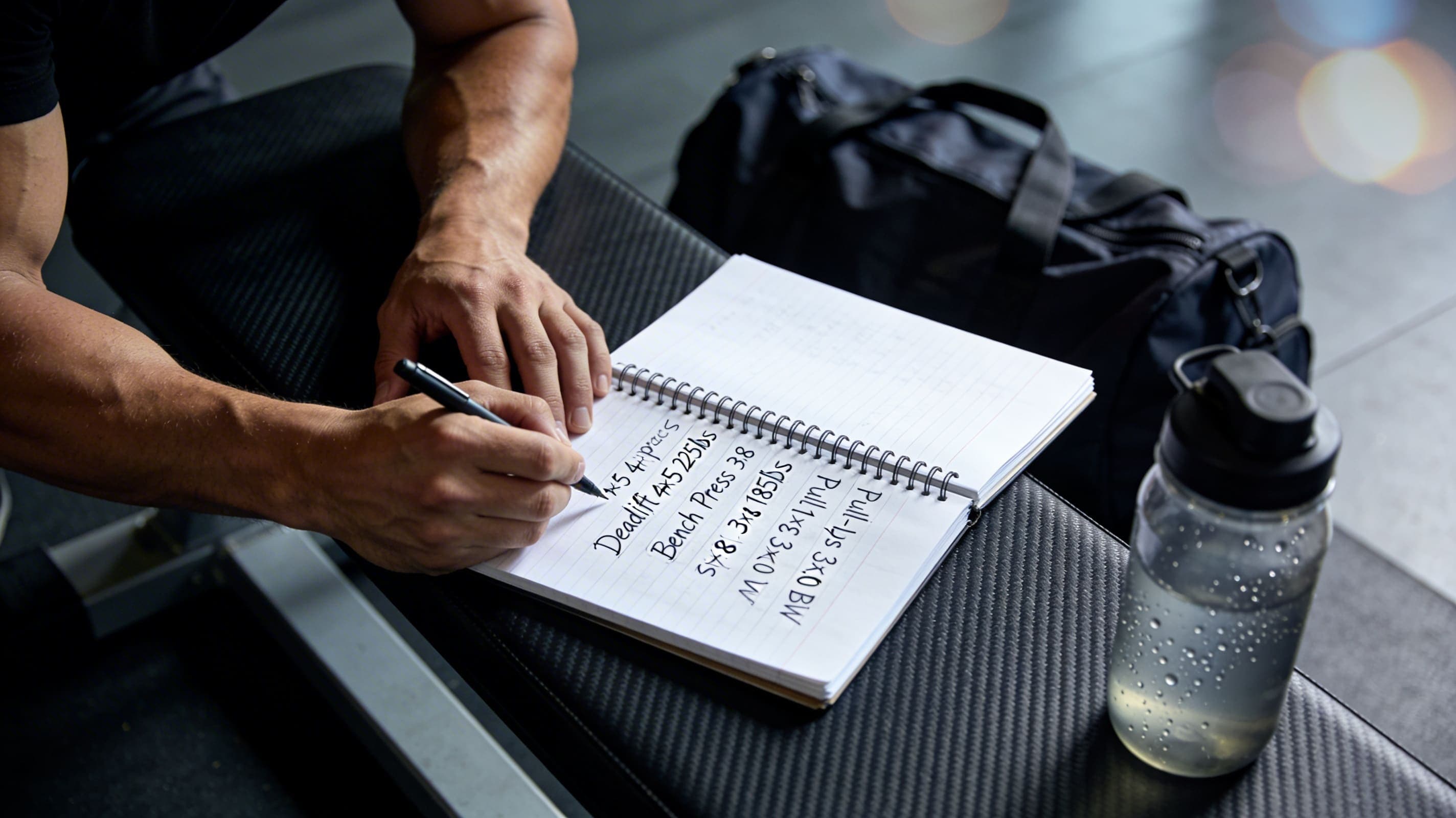
You can't apply progressive overload without knowing what you did last time. Yet many lifters train "by feel." At a minimum, log:
- The exercise and its variation.
- The weight and reps for each set.
- Effort (RIR or RPE) on key sets.
- Context: sleep, pain, fatigue.
With that data, every workout has a clear target: beat last time by one rep or one weight increment. A workout tracker automates this and flags plateaus for you.
Progressive overload mistakes to avoid
- Sacrificing form for weight: more weight with a shorter range of motion isn't progress.
- Progressing too fast: tendons adapt more slowly than muscles. Sudden jumps in volume or load are a leading cause of tendon pain.
- Program hopping every two weeks: without consistent exercises, you can't measure progress.
- Trying to progress everything at once: during a cut or a busy period, maintaining is already a win.
- Expecting a straight line: one bad session isn't a plateau. Look at the trend over 4 to 6 weeks.
Progressive overload: the recap
- Your body only keeps adapting if the stimulus keeps increasing.
- Weight, reps, sets, technique, frequency and density are all forms of progressive overload.
- Double progression (8 to 12 reps, then +2.5 to 5%) works for most lifters.
- Log every workout so you always know what to beat.
- When you plateau: fix the basics, deload, change the method, then the variation.
That's exactly what mebody is built for: the app logs your sets, estimates your 1RM, spots plateaus and adjusts your weights with its adaptive progression engine. Try it free for 14 days, no credit card required.
Ready to progress?
mebody adapts your program in real time based on your performance — no more generic plans.