



Beginner Gym Workout Plan: Your First 12 Weeks at the Gym
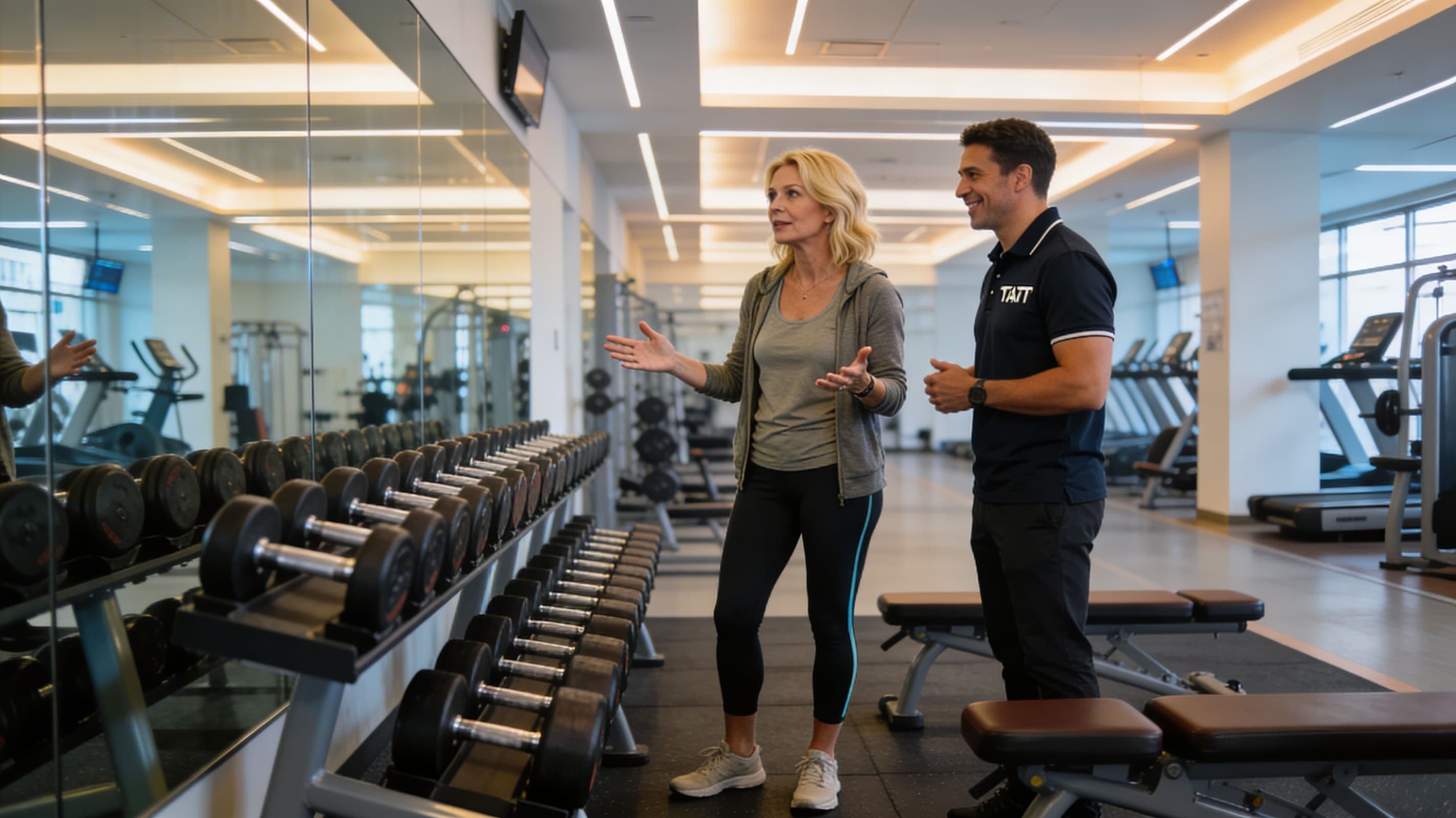
Just signed up for a gym membership and not sure where to start? A good beginner gym workout plan is simpler than most people think: three sessions a week, a handful of compound exercises, weights that go up a little every week and a record of what you did. This guide gives you a complete beginner workout plan you can follow for 12 weeks, with exact sets, reps, rest times and a clear method for adding weight.
The goal is to get out of the "I'll just do a bit of everything" phase and into measurable progress. That is what separates people who transform their body in three months from people who quit after three weeks.
5 Rules Every Beginner Workout Plan Should Follow
Before you look at the workouts, lock in these five principles. They matter more than the exact exercise selection.
- Consistency beats intensity: three solid workouts a week for 12 weeks will always beat six brutal workouts a week for three weeks.
- Compound lifts first: squats, bench press, rows, pulldowns and Romanian deadlifts train several muscles at once and give you the best return on your time.
- Moderate volume: about 10 to 12 hard sets per muscle group per week is plenty for a beginner. Beyond that, fatigue rises faster than results.
- Progressive overload: every week, try to do slightly more than last time, either one more rep or a little more weight.
- Log everything: without a record of your weights and reps, you cannot tell whether you are actually progressing.
3 or 4 Days a Week: Which Beginner Gym Workout Should You Pick?
Two structures work especially well for beginners. The right one mostly depends on your schedule.
| Factor | Full body, 3 days | Upper/lower, 4 days |
|---|---|---|
| Sessions per week | 3 (e.g. Mon, Wed, Fri) | 4 (e.g. Mon, Tue, Thu, Fri) |
| Frequency per muscle | 3x per week | 2x per week |
| Session length | 50-60 min | 45-55 min |
| Best for | Total beginners, busy schedules | Beginners with 6-8 weeks of training |
| Main strength | Fast technique learning | More volume per session for each area |
If you have never touched a barbell, start with three days. You can switch to four days from week 7 if you are recovering well. For a deeper dive into full-body training, including a two-day and a home version, read our full body workout for beginners.
The Beginner Workout Plan: 3 Days (Weeks 1-6)
You alternate two workouts, A and B. Week 1: A-B-A. Week 2: B-A-B. And so on. Keep at least one rest day between sessions.
Workout A
| Exercise | Sets | Reps | Rest |
|---|---|---|---|
| Leg press or goblet squat | 3 | 10-12 | 2 min |
| Dumbbell bench press | 3 | 8-12 | 2 min |
| Lat pulldown | 3 | 10-12 | 90 sec |
| Lying or seated leg curl | 2 | 10-15 | 90 sec |
| Dumbbell lateral raise | 2 | 12-15 | 60 sec |
| Plank | 3 | 30-45 sec | 45 sec |
Workout B
| Exercise | Sets | Reps | Rest |
|---|---|---|---|
| Dumbbell Romanian deadlift | 3 | 8-10 | 2 min |
| Seated dumbbell shoulder press | 3 | 8-12 | 90 sec |
| Seated cable row or machine row | 3 | 10-12 | 90 sec |
| Dumbbell reverse lunge | 2 | 10 per leg | 90 sec |
| Push-ups (or machine chest press) | 2 | 8-15 | 60 sec |
| Cable curl + triceps pushdown | 2 + 2 | 12-15 | 60 sec |
These first six weeks deliberately mix machines and dumbbells. Machines (leg press, pulldown, row) teach you the movement without the balance challenge. Dumbbells force each side to work on its own and fix left-right imbalances. You can find step-by-step instructions for every movement in our exercise database.
Warm-Up: 8 Minutes Is Enough
- 3 to 5 minutes on the bike or rower at an easy pace.
- Mobility: 10 arm circles, 10 hip circles, 10 bodyweight squats.
- On your first exercise: one very light set of 15 reps, then one set of 8 reps at about 50% of your working weight.
Optional 4-Day Upper/Lower Split (Weeks 7-12)
After six weeks, your movements are more confident and you recover faster. If you can train four times a week, this beginner gym workout raises your weekly volume while keeping each session short. If not, stay on the three-day plan and swap the leg press for the barbell back squat and the dumbbell press for the barbell bench press.
| Day | Session | Main exercises (sets x reps) |
|---|---|---|
| Monday | Upper 1 | Barbell bench press 3x6-8, barbell row 3x8-10, dumbbell shoulder press 3x10, lat pulldown 3x10-12, curl 2x12 |
| Tuesday | Lower 1 | Back squat 3x6-8, Romanian deadlift 3x8-10, leg extension 2x12-15, calf raise 3x12-15, plank 3x40 sec |
| Thursday | Upper 2 | Incline dumbbell press 3x8-10, assisted pull-ups 3x6-10, one-arm dumbbell row 3x10, lateral raise 3x15, triceps extension 2x12 |
| Friday | Lower 2 | Leg press 3x10-12, hip thrust 3x8-12, walking lunge 2x10/leg, leg curl 3x12, hanging knee raise 3x10 |
On heavy lifts in the 6-8 rep range, rest 2 to 3 minutes. On isolation exercises, 60 to 90 seconds is enough.
How to Pick Your Weights and Keep Progressing
This is what really makes the difference. A workout plan without a progression rule is just a list of exercises.
The Double Progression Method
Every exercise has a rep range, say 8-12. Here is the rule:
- Choose a weight you can lift for at least 8 clean reps on every set.
- Each session, try to add one rep to one or more sets.
- Once you hit 12 reps on all sets, increase the weight: 5 to 10 lb for lower body, 2.5 to 5 lb for upper body.
- You will drop back to about 8-9 reps, then repeat the cycle.
This method, covered in depth in our guide to progressive overload, keeps beginners progressing for months.
How Hard Should Each Set Be?
Stop most sets with 1 to 3 reps in reserve, meaning you could have done 1 to 3 more reps with good form. Going to failure on every set does not build more muscle in beginners, and it increases fatigue and the risk of sloppy reps.
To estimate your strength without risking a true max attempt, log a set of 5 to 10 reps in the mebody workout tracker to get an estimated 1RM. It helps you set sensible working weights from week 7 onward.
Your 12-Week Roadmap
| Weeks | Goal | What you actually do |
|---|---|---|
| 1-2 | Learn | Light weights, 2 sets per exercise, focus on technique and full range of motion |
| 3-6 | Build | 3 sets, double progression every session, first weight increases |
| 7 | Deload | Lighter week: same exercises, 2 sets, about 80% of your working weights |
| 8-11 | Progress | Switch to 4 days (optional) or barbell full body, 6-8 reps on the big lifts |
| 12 | Review | Compare weights, photos and measurements with week 1, then plan what comes next |
As a rough benchmark, a beginner who follows this plan seriously can often increase the weight on the main lifts by 20 to 50% in 12 weeks. Individual differences are large: age, sleep, nutrition and training history all play a big role.
Machines vs. Free Weights for Beginners
It is a false choice. Each tool has a job in a beginner gym workout.
- Machines: easy to learn, safe when training alone, great for isolating a muscle (leg curl, leg extension, pec deck). Ideal in weeks 1 to 6.
- Dumbbells: free range of motion, single-arm and single-leg work, a good balance of safety and effectiveness.
- Barbell: lets you lift the heaviest loads and progress in small increments. Introduce it once the movement pattern is solid.
- Cables: constant tension through the whole movement, perfect for arms, shoulders and back.
If the gym is packed and your machine is taken, swap in an exercise with the same movement pattern (horizontal push, vertical pull and so on) instead of skipping it.
Recovery and Nutrition: The Two Overlooked Levers
Muscle is built between sessions, not during them. Three basics are enough to start:
- Protein: aim for about 0.7 to 1 g per pound of body weight per day (1.6 to 2.2 g/kg), spread over 3 to 4 meals.
- Calories: to build muscle, a small surplus of 200 to 300 calories a day. To lose fat while keeping muscle, a moderate deficit of 300 to 500 calories. For the full picture, see our guide on how to build muscle.
- Sleep: 7 to 9 hours a night. Short sleep cuts strength, motivation and recovery.
Soreness in the first few weeks is normal and drops sharply after two to three weeks of regular training. Sharp joint pain is not normal: lower the weight and check your form.
What to Do on Rest Days
Rest days are part of the plan, not a break from it. Your muscles repair and grow on these days, so treat them as active recovery rather than couch time.
- Walk: 20 to 45 minutes of easy walking boosts blood flow, helps with soreness and adds to your daily activity without hurting recovery.
- Mobility: 10 to 15 minutes on hips, ankles and upper back makes squats, presses and rows feel smoother.
- Light cardio: an easy bike ride or swim is fine. Keep hard intervals away from the day before leg workouts.
- Prep for the next session: check what is on the schedule, note the weights you are aiming for and get to bed on time.
One full rest day per week with no structured exercise at all is a good habit, especially in your first months. If you feel unusually tired, irritable or your lifts drop two sessions in a row, add an extra rest day before changing anything else in the program.
Mistakes That Keep Beginners Stuck
- Switching programs every two weeks: your body never gets time to adapt and you cannot measure progress. Stick with one plan for at least 8 to 12 weeks.
- Skipping leg day: your legs and glutes make up roughly half of your muscle mass. Squats, leg press, Romanian deadlifts and lunges are non-negotiable.
- Adding weight too fast: if your form breaks down (rounded back, shorter range of motion), the weight is too heavy.
- Doing too much volume: 25 sets per session will not get you better results than 15 good ones, just a lot more fatigue.
- Training by feel: without a log or an app, you forget your numbers and repeat the same workout for months.
Track Your Progress Workout by Workout
Logging your weights, reps and how each session felt is the most reliable way to keep progressive overload going. It also helps you spot a plateau early and adjust before you lose motivation. A workout progress tracker shows the trend for each exercise: weights, volume and personal records.
If you would rather not build everything by hand, mebody can generate a workout plan matched to your level, equipment and schedule, suggest the weights to aim for and log every set during your session. You can also import a plan you already follow as text or a PDF. The 14-day Pro trial is free with no credit card, so the easiest move is to try it during your first two weeks at the gym.
Key Takeaways
- Start with three full-body workouts a week, mixing machines and dumbbells.
- Use double progression: add reps first, then weight.
- Plan a lighter week around week 7, then consider a four-day upper/lower split.
- Eat enough protein, sleep enough and log every workout.
- Review your progress at week 12 before changing programs.
Ready to progress?
mebody adapts your program in real time based on your performance — no more generic plans.